
Last Updated on October 15, 2026
If you’re still comparing products, take a look at our guide to the best concrete sealers for different surfaces.
Pool Deck Sealer Quick Facts
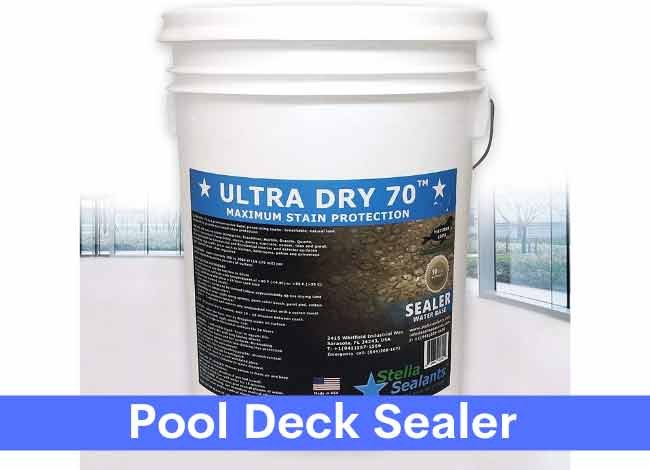
- Product Name: Ultra Dry 70 Stone Sealer
- Manufacturer: Stella Sealants Corporation
- Brand Origin: United States
- Sealer Type: Water-based penetrating and impregnating sealer
- Color: Clear
- Finish: Natural look
- Suitable Materials: Natural stone, concrete, pavers, tile, grout, and other approved porous surfaces
- Application: Interior and exterior, residential and commercial
- Coverage: Approximately 200–3,000 square feet per gallon, depending on porosity
- Application Temperature: 40°F–95°F (4.4°C–35°C)
- Second Coat: After 10–15 minutes, if required
- Surface Use: Avoid heavy traffic for 24 hours
- Appearance: Designed to preserve the original appearance of stone
Pool Deck Stain-Proof Premium Sealer Reviews 2026
When it comes to protecting a pool deck, a penetrating sealer is often a practical choice. Instead of creating a thick visible coating, it works within the pores of the surface to help resist moisture and stains.
The Ultra Dry 70 Stone Sealer is a premium water-based, breathable, penetrating sealer manufactured by Stella Sealants Corporation. It is designed to protect porous natural stone while maintaining its original color and appearance.
One of the biggest advantages of this sealer is its versatility. You can use it on several types of natural stone, including travertine, marble, limestone, granite, slate, and sandstone. It is also listed for use on suitable concrete, pavers, tile, grout, stucco, and terracotta.
That makes it useful for homeowners who have more than one type of stone surface around the house. For example, you may have a travertine pool deck, concrete walkway, and stone patio that all need protection.
However, this product is a sealer, not a crack repair compound. If your pool deck has open cracks, missing grout, or damaged pavers, repair those problems with appropriate materials before sealing.
 Check Foundation Armor WL550 Price on Amazon
What Makes Ultra Dry 70 Pool Deck Sealer Different?
Ultra Dry 70 is manufactured by Stella Sealants Corporation, a company that offers sealing, enhancing, and cleaning products for stone and masonry surfaces.
The product is designed to penetrate porous materials rather than leave a thick film on top. This helps preserve the original appearance of natural stone while reducing the amount of water and staining material that can enter the surface.
Its water-based formula is another attractive feature. Water-based penetrating sealers are generally easier to handle and clean up than many solvent-based coatings, although their actual safety and environmental impact depend on the specific formulation.
Ultra Dry 70 can be used on horizontal and vertical surfaces, making it useful for patios, pool surrounds, stone walls, bathrooms, kitchen surfaces, and walkways.
Its manufacturer also advertises protection against saltwater exposure and efflorescence. These features are particularly relevant for pool decks and outdoor stone surfaces that frequently come into contact with moisture.
For homeowners comparing water-repellent products, our article on penetrating concrete sealers explains how these products differ from surface coatings.
Can Ultra Dry 70 Be Used on Travertine Pool Decks?
Yes. Travertine is one of the natural stones specifically listed by the manufacturer as suitable for Ultra Dry 70.
Travertine is popular around swimming pools because of its attractive appearance and natural texture. However, it is porous and can absorb water, pool chemicals, and stains if left unprotected.
A penetrating sealer helps reduce that absorption without intentionally creating a glossy finish. This is useful if you want to maintain the natural beauty of your travertine rather than give it a shiny, coated appearance.
Before sealing, check whether your travertine has already been treated with another product. Existing coatings or impregnating sealers may affect penetration.
Always test a small area first. Even products marketed as natural-look sealers can change the appearance of some stones, depending on their composition and porosity.
What Do You Need to Do Before Sealing a Pool Deck?
Before sealing a pool deck, driveway, patio, or walkway, you should clean the surface thoroughly. Dirt, oil, algae, and other contaminants can prevent the sealer from penetrating properly.
Use a mild detergent and a suitable brush to remove surface dirt. For stubborn stains, choose a cleaner approved for the particular stone or concrete surface.
A pressure washer may help on some durable outdoor surfaces, but excessive pressure can damage soft travertine, deteriorating grout, or delicate stone. Always use a surface-appropriate cleaning method.
For more detailed preparation advice, read our guide on how to clean a driveway before applying sealer.
Step 1: Remove Dirt and Debris
Start by sweeping the pool deck to remove loose leaves, dust, and debris. Pay attention to joints between pavers and areas near the pool edge where dirt may collect.
Remove any loose or flaking previous coating if necessary, using a method suitable for the surface. Do not apply a penetrating sealer directly over an incompatible film-forming coating.
Step 2: Clean Oil Stains and Other Contaminants
Use an appropriate stone-safe cleaner to remove grease, oil, or other stains. Avoid acidic cleaners on marble, limestone, and travertine because they can etch the stone.
After cleaning, rinse the surface thoroughly and remove any remaining cleaning solution.
Step 3: Allow the Surface to Dry
Ultra Dry 70 should be applied to a clean, dry surface. The manufacturer recommends allowing approximately 24 hours of drying time after cleaning, depending on weather conditions.
Shaded areas, high humidity, and porous stone may require additional drying time.
Step 4: Test a Small Area
Before covering the entire deck, apply a small amount of sealer in an inconspicuous location.
Let the test area dry and inspect the finish. Make sure the appearance meets your expectations and the product is suitable for the surface.
Step 5: Apply the Pool Deck Sealer
Stir Ultra Dry 70 thoroughly before use. Do not dilute it.
Depending on the surface, you can apply it with a low-pressure sprayer, paint roller, brush, paint pad, or cotton towel.
Spread the product evenly and allow it to penetrate the surface. After approximately 5–10 minutes, remove any sealer that has not been absorbed using a clean cotton towel.
Do not leave excess sealer to dry on top of the stone. This can create an uneven appearance or unwanted surface residue.
Step 6: Apply a Second Coat If Necessary
Not every surface requires a second coat. Highly porous stone may absorb more sealer than dense stone and benefit from another application.
If an additional coat is needed, the manufacturer recommends waiting approximately 10–15 minutes between coats.
After about one hour, place a few drops of water on the treated surface. If the water is quickly absorbed, another coat may be needed according to the product instructions.
Step 7: Allow the Surface to Cure
Keep the treated surface protected during the initial drying period. The manufacturer advises avoiding heavy usage on horizontal surfaces for at least 24 hours.
For a pool deck, avoid exposing the fresh treatment to unnecessary water, cleaning chemicals, or heavy traffic until the sealer has adequately dried.
Do not return the pool deck to service earlier than the product label permits.
Why Buy Ultra Dry 70 Pool Deck Sealer?
There are several reasons why Ultra Dry 70 may be a good option for homeowners with natural stone or concrete pool surrounds.
- Water-based formula: Convenient for residential applications and generally easier to clean up than many solvent-based alternatives.
- Natural appearance: Designed to preserve the original look of natural stone.
- Penetrating protection: Helps reduce absorption of water and staining substances.
- Wide compatibility: Suitable for many types of natural stone, concrete, grout, and other approved porous materials.
- Interior and exterior use: Can be used around pools, patios, bathrooms, walkways, and other suitable locations.
- Commercial and residential applications: Intended for different levels of use when the substrate and conditions are appropriate.
- Saltwater resistance: Particularly relevant for some poolside and coastal environments.
- Flexible application: Can be applied using several common tools.
Environmental Impact of Water-Based Pool Deck Sealers
Many homeowners prefer water-based sealers because they generally have a milder odor and may contain fewer volatile organic compounds than certain solvent-based products.
Ultra Dry 70 uses a water-based formula, which can make it a practical option for projects around residential outdoor living areas.
However, water-based does not automatically mean non-toxic or completely environmentally harmless. The product’s safety information warns that it can cause eye irritation and should be handled carefully.
Wear suitable protective equipment, avoid inhaling application mist, and prevent runoff into swimming pools, drains, or nearby waterways.
Keep children and pets away from the area during application and until the surface is ready for use.
Choosing a sealer suited to the material is just as important as choosing a water-based formula. A properly applied product can reduce the need for premature maintenance and unnecessary repeat applications.
Pool Deck Sealer Application Tips and Techniques
Proper application is the key to getting the most out of your sealer. Even a high-quality product may perform poorly if applied to a wet, dirty, or incompatible surface.
For the best results, keep these tips in mind:
- Follow the temperature limits. Ultra Dry 70 should not be applied to surfaces below 40°F or above 95°F.
- Avoid direct exposure to harsh application conditions. Extremely hot surfaces, strong winds, and unexpected rain can affect the finish.
- Stir before applying. Do not add water or other thinning agents.
- Apply evenly. Use the right applicator for the size and texture of the surface.
- Remove excess product. Wipe away unabsorbed sealer within the manufacturer’s recommended time.
- Do not automatically apply multiple coats. Check whether the surface actually needs more sealer.
- Respect drying requirements. Allow sufficient time before reopening the deck to heavy use.
If you’re sealing decorative or patterned concrete rather than natural stone, our stamped concrete sealer reviews may help you compare other suitable finishes.
Water-Based vs. Solvent-Based Pool Deck Sealers
Both water-based and solvent-based sealers can protect pool decks, but they are not interchangeable. The best choice depends on the surface material, appearance you want, previous treatments, and application conditions.
| Feature | Water-Based Penetrating Sealer | Solvent-Based Enhancing Sealer |
|---|---|---|
| Example | Stella Ultra Dry 70 Stone Sealer | Foundation Armor WL550 |
| Finish | Natural look | Matte wet-look enhancement |
| Main Purpose | Reduce water and stain absorption | Reduce water absorption and enhance color |
| Odor | Generally milder | Solvent odor; ventilation required |
| Application | Brush, roller, pad, towel, or suitable sprayer | Solvent-resistant sprayer recommended |
| Appearance Change | Intended to preserve natural stone color | Designed to slightly darken or enrich color |
| Best Choice | When a natural-looking finish is preferred | When subtle matte color enhancement is desired |
One isn’t automatically better than the other. If you want your travertine or natural stone to look almost unchanged, Ultra Dry 70 may be the more suitable option.
If you prefer a darker, matte wet-look finish, a compatible enhancing sealer may be worth considering.
For a closer look at that product, read our Foundation Armor WL550 sealer review.
Foundation Armor WL550: An Alternative Pool Deck Sealer
Foundation Armor WL550 is another option for homeowners who want to protect certain unsealed concrete, paver, and natural stone surfaces.
Unlike Ultra Dry 70, WL550 is a solvent-based penetrating sealer designed to slightly enhance the natural color of the material while leaving a matte wet-look appearance.
Its manufacturer lists pool decks, patios, driveways, and other suitable exterior surfaces among its applications.
However, WL550 should not be applied over incompatible existing sealers, and it requires a different application process from Ultra Dry 70.
Foundation Armor currently lists approximate coverage of 175–225 square feet per gallon, depending on surface porosity and preparation. Its technical data sheet also provides separate waiting periods for foot and vehicle traffic.
If you are considering WL550, follow the manufacturer-specific directions rather than the Ultra Dry 70 instructions in this review.
How Much Pool Deck Sealer Do You Need?
Before purchasing a pool deck sealer, measure the area that needs treatment. Multiply the length by the width to calculate the square footage.
For example, a rectangular pool deck measuring 20 feet by 30 feet has an area of 600 square feet.
Ultra Dry 70’s published coverage range is approximately 200–3,000 square feet per gallon. This is a very wide range because dense and porous stone surfaces absorb different amounts of material.
If your 600-square-foot pool deck absorbs one gallon per 300 square feet, you would need approximately two gallons for that application. However, the actual amount may be considerably lower or higher.
Use a small test area to estimate absorption before buying large quantities. It is also helpful to check the manufacturer’s coverage recommendations for your specific material.
Pros and Cons of Ultra Dry 70 Pool Deck Sealer
Pros
- Water-based formula
- Designed for a natural, clear finish
- Suitable for a wide range of porous stone surfaces
- Helps reduce moisture and stain absorption
- Can be used indoors and outdoors
- Works on horizontal and vertical surfaces
- Suitable for many travertine pool decks
- Does not intentionally create a glossy surface film
Cons
- May cost more than some basic sealing products
- Not suitable for every previously sealed surface
- Does not repair structural cracks or damaged grout
- Coverage varies significantly with surface porosity
- Not suitable if you want a dramatic glossy wet-look finish
- May need another coat on highly absorbent materials
How Long Does Pool Deck Sealer Last?
The lifespan of a pool deck sealer depends on several factors, including the type of product, surface porosity, weather exposure, traffic, and cleaning methods.
A lightly used stone patio may retain water repellency longer than a busy pool deck exposed to frequent splashing, cleaning chemicals, and direct sunlight.
For Ultra Dry 70, the manufacturer’s currently available product information does not establish a universal resealing interval that applies to every installation.
Rather than assuming the product will last a specific number of years, inspect the surface periodically. If water begins soaking into previously protected stone more quickly than before, it may be time to evaluate whether another treatment is needed.
Do not apply another coat automatically every year. Excess sealer can cause residue or uneven results if the existing treatment is still effective.
Is Ultra Dry 70 Pool Deck Sealer Worth Buying?
If you have a travertine, marble, limestone, or another compatible porous stone pool deck, Ultra Dry 70 is worth considering.
Its biggest advantage is that it provides penetrating protection without intentionally changing the natural appearance of the stone. This is particularly useful for decorative pool surrounds where the original texture and color are important.
It is also versatile enough for several other stone and masonry areas around the home.
However, if you want a glossy or noticeably darker finish, you may prefer another type of sealer. And if your deck has structural damage, sealing alone will not solve the problem.
Overall, the product is better suited to preventive protection and routine maintenance than major surface restoration.
Conclusion: Pool Deck Sealer Reviews 2026
The Ultra Dry 70 Stone Sealer is a practical water-based sealer for homeowners who want to protect natural stone without changing its original appearance.
It is suitable for many types of stone, including travertine, limestone, marble, granite, and slate. Its penetrating formula helps reduce moisture and stain absorption while maintaining a natural-looking finish.
The application process is fairly straightforward. Clean and dry the surface, test a small area, apply the product evenly, remove excess material, and allow enough time before returning the surface to regular use.
As with any penetrating sealer, proper preparation matters. Choosing the correct product for your surface and following the manufacturer’s instructions will make a greater difference than simply applying more coats.
For homeowners seeking a natural finish rather than a shiny coating, Ultra Dry 70 is a reasonable option to consider. If you prefer a slightly enhanced wet-look appearance, Foundation Armor WL550 may be another alternative, provided it is compatible with your surface.
Frequently Asked Questions About Pool Deck Sealers
1. How do I choose the best pool deck sealer?
Start by identifying your pool deck material. Concrete, travertine, pavers, and other natural stones may need different sealers. Look for a product designed for your surface, consider whether you want a natural or wet-look finish, and check the manufacturer’s application and maintenance instructions.
2. How can I keep my pool deck clean?
Sweep the deck regularly and clean stains as soon as possible. Use a mild cleaner suitable for the surface material. Avoid harsh acids on travertine, marble, and limestone, and use pressure washing carefully to prevent damage.
3. Is a second coat of pool deck sealer always necessary?
No. The number of coats depends on the product and the absorbency of the surface. Ultra Dry 70 allows an additional coat after approximately 10–15 minutes if needed. Follow the manufacturer’s instructions rather than automatically applying two coats.
4. Can I use Ultra Dry 70 on a travertine pool deck?
Yes. Travertine is one of the natural stones listed by Stella Sealants as suitable for Ultra Dry 70. Make sure the surface is clean, dry, and compatible with the product before application.
5. How long should I wait before using the pool deck after sealing?
Stella Sealants recommends avoiding heavy use of horizontal surfaces for at least 24 hours after applying Ultra Dry 70. Weather and surface conditions can affect drying, so follow the current product label.
6. Does pool deck sealer make the surface slippery?
It depends on the sealer and the texture of the surface. Penetrating sealers generally do not create the same surface film as glossy coatings, but no sealer guarantees a slip-proof finish. Always test the treated surface and maintain adequate traction, especially around swimming pools.
I applied Ultra Dry 70 on my Travertine tiles in my house. Went back over 24 hrs later and it was still tacky when walked on. I put the same sealer on my upstairs tiles which are also Travertine and the floors were not tack the next day Why would this happen ?
Thanks for this Pool Deck Sealer Article. I got the information that I searching for.