
Last Updated on October 15, 2026
That’s why I’ve selected a few Henry sealers worth considering for residential asphalt driveways. Some are designed for minor cracks and routine maintenance, while others provide a more rubberized coating for rough or aging blacktop.
In these Henry Driveway Sealer Reviews 2026, we’ll compare the Henry 532 Driveway Asphalt Resurfacer and Henry 200 E-Z Stir Asphalt Filler & Sealer, along with the product names and packaging variations that shoppers may encounter.
We’ll also cover application methods, coverage, drying time, advantages, drawbacks, and the common mistakes to avoid when sealing a driveway.
If you’re still comparing brands, our guide to the best driveway sealers for homeowners can help you explore other options.
Henry Driveway Sealer Quick Facts
- Brand: Henry
- Main Products Reviewed: Henry 532 Asphalt Resurfacer and Henry 200 E-Z Stir
- Surface Type: Asphalt and blacktop
- Typical Container Size: Approximately 5 gallons, depending on packaging
- Coverage: Approximately 250–500 sq. ft. per 5-gallon pail for Henry 200 and 532
- Color: Black after drying
- Dry-to-Touch Time: Approximately 4 hours under specified conditions
- Vehicle Traffic: Follow the specific product’s curing instructions; typically plan for at least 24–48 hours
- Minimum Application Temperature: 50°F (10°C) and rising for Henry 532
- Freeze Protection: Do not allow the product to freeze
- Warranty: 4-year or 7-year limited warranty, depending on the product
These specifications apply to the particular Henry products reviewed below. Surface condition, temperature, humidity, and application thickness can affect the results.
Top 3 Henry Driveway Sealer Reviews 2026
Henry is a well-known brand in driveway maintenance, offering asphalt coatings, crack fillers, patching materials, and resurfacing products. Its sealers are designed to help protect asphalt from weather exposure while improving the appearance of faded pavement.
In this review, we’ll discuss three product listings commonly associated with the Henry driveway sealer range.
It’s worth mentioning that the first and third listings are related to the same Henry 532 Asphalt Resurfacer. They may use different names or model numbers depending on the retailer, but they should not be treated as three completely different sealer formulas.
1. Henry Black Driveway Sealer HE532410
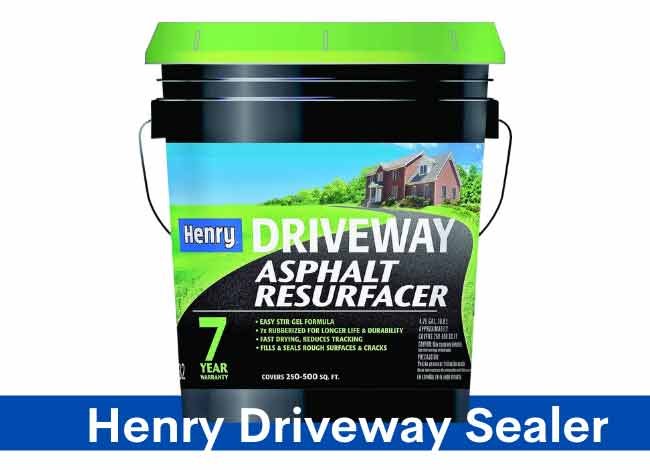
The Henry HE532410 Driveway Asphalt Resurfacer is an excellent option for homeowners who want to refresh an older blacktop driveway. This product belongs to Henry’s 532 series and is designed to fill and seal rough surfaces and minor cracks.
It features a 7X rubberized formulation that provides flexibility and durability. The easy-stir gel formula also makes application more manageable for homeowners handling their own driveway maintenance.
Once applied correctly, the coating dries to a rich black finish that can make faded asphalt look cleaner and more uniform.
Another useful feature is its relatively fast drying. Under controlled conditions of approximately 68°F and 50% relative humidity, Henry’s technical data lists a dry-to-touch time of around four hours.
However, dry to the touch does not mean ready for vehicle traffic. Depending on the weather, it may take considerably longer before you can safely drive on the finished surface.
The product also carries a 7-year limited warranty against qualifying manufacturing defects. This warranty does not guarantee that every driveway coating will remain in perfect condition for seven years.
Technical Specifications of Henry HE532410
| Feature | Henry HE532410 Details |
|---|---|
| Product Series | Henry 532 Driveway Asphalt Resurfacer |
| Package | 5 gallons; some retail variants use 4.75-gallon packaging |
| Coverage | 250–500 sq. ft. per 5-gallon pail |
| Color | Black after drying |
| Formula | 7X rubberized, easy-stir gel |
| Application Temperature | 50°F (10°C) and rising |
| Dry to Touch | Approximately 4 hours under specified conditions |
| Application Method | Brush side of a squeegee or suitable roller |
| Number of Coats | One coat under the manufacturer’s technical instructions |
| Warranty | 7-year limited warranty |
| Surface Compatibility | Asphalt and blacktop |
| Price |

Pros of Henry HE532410
- Easy-stir gel formula is convenient for DIY applications
- 7X rubberized for additional flexibility
- Helps seal rough asphalt and minor surface cracks
- Dries to a rich black finish
- Relatively fast dry-to-touch time
- Can reduce tracking when applied correctly
- Backed by a 7-year limited warranty
Cons of Henry HE532410
- Thick application can leave marks or cause tracking
- Requires suitable weather conditions
- Cannot repair deep cracks or structural damage
- Not suitable for concrete driveways
- Only one coat should be applied under the manufacturer’s instructions
Our assessment: Henry 532 is a practical choice for aging asphalt that is still structurally sound. Its rubberized formula and attractive black finish are useful, but proper application is essential. Applying too much material can do more harm than good.
If you prefer a different type of finish, our acrylic driveway sealer buying guide explains the characteristics of acrylic-based coatings.
2. Henry E-Z Stir Driveway Asphalt Sealer HE20041
The Henry E-Z Stir Driveway Asphalt Filler & Sealer is another popular product for maintaining residential asphalt driveways. It’s designed for homeowners who want an easy-to-stir sealer that improves the appearance of blacktop while filling small surface cracks.
Henry 200 uses a 4X rubberized formulation and is reinforced for improved traction and durability. It is suitable for asphalt with minor cracks measuring up to approximately 1/8 inch wide.
This makes it a useful option for driveways that have faded over time but don’t yet need extensive repairs.
The product covers approximately 250–500 square feet per 5-gallon pail, depending on surface texture and porosity. A smooth, previously sealed driveway generally requires less material than rough, weathered asphalt.
One of its main advantages is its easy-stir formula. It is designed to simplify the mixing and spreading process, making it more manageable for first-time users.
Henry lists a dry-to-touch time of approximately four hours and provides a 4-year limited warranty.
Technical Specifications of Henry E-Z Stir HE20041
| Feature | Henry E-Z Stir Details |
|---|---|
| Product Series | Henry 200 Driveway E-Z Stir |
| Package | 5 gallons; packaging may vary |
| Maximum Minor Crack Width | 1/8 inch |
| Coverage | 250–500 sq. ft. per 5-gallon pail |
| Color | Black after drying |
| Formula | 4X rubberized, easy-stir asphalt filler and sealer |
| Dry to Touch | Approximately 4 hours under suitable conditions |
| Vehicle Traffic | Follow container directions and allow adequate curing time |
| Warranty | 4-year limited warranty |
| Best For | Residential asphalt with minor cracks and surface wear |
| Price |

Pros of Henry E-Z Stir
- Easy-to-stir and apply formula
- 4X rubberized for improved durability
- Fills minor asphalt cracks up to 1/8 inch
- Provides a clean black finish
- Reinforced for improved traction
- Suitable for routine driveway maintenance
- Comes with a 4-year limited warranty
Cons of Henry E-Z Stir
- Rough surfaces may require more material
- Not intended for deep cracks or potholes
- Drying can take longer in cool or humid conditions
- The black finish can gradually fade with weather and traffic
- Not compatible with concrete surfaces
Our assessment: Henry E-Z Stir is a good choice for homeowners who want a straightforward asphalt sealer without paying for a more premium resurfacing formula.
For comparison, you can also read our BlackJack asphalt filler and sealer review.
3. Henry 532 Driveway Asphalt Resurfacer
If you have a rough or weathered asphalt driveway, Henry 532 Driveway Asphalt Resurfacer is worth considering. This is the same product family discussed in the first review, but retailers may list it under different package codes or product descriptions.
Henry 532 is designed to fill and seal minor imperfections while improving the appearance of faded blacktop. Its 7X rubberized formula helps provide flexibility and durability under normal driveway conditions.
The product also features an easy-stir gel consistency. You can spread it using the brush side of a driveway squeegee or a suitable roller, following the manufacturer’s instructions.
One of the most important application rules is to avoid thick coats. Henry specifically advises against applying more than one coat because excess material can lead to slow drying, cracking, and tracking.
For the best results, apply the product when the temperature is at least 50°F and rising. Do not begin if rain, frost, or temperatures below 50°F are expected within the next 48 hours.
The manufacturer also advises against using the resurfacer on asphalt that is less than six months old.
Technical Specifications of Henry 532 Asphalt Resurfacer
| Feature | Henry 532 Details |
|---|---|
| Product | Henry 532 Driveway Asphalt Resurfacer |
| Package | 5-gallon nominal size; 4.75-gallon retail variants also exist |
| Application Temperature | 50°F (10°C) and rising |
| Dry-to-Touch Time | Approximately 4 hours under specified conditions |
| Coverage | 250–500 sq. ft. per 5-gallon pail |
| Color | Black |
| Formula | 7X rubberized gel |
| Surface Compatibility | Asphalt and blacktop |
| Application Tool | Brush side of squeegee or suitable roller |
| Warranty | 7-year limited warranty |
| Price |

Pros of Henry Asphalt Resurfacer
- 7X rubberized formula for improved flexibility
- Easy-stir gel consistency
- Helps fill minor cracks and rough asphalt surfaces
- Leaves a rich black appearance
- Suitable for typical residential asphalt driveways
- Can be applied with a squeegee or suitable roller
- 7-year limited warranty
Cons of Henry Asphalt Resurfacer
- Not suitable for concrete
- Cannot fix serious structural deterioration
- Too much material can cause tracking
- Requires favorable drying conditions
- Must not be applied to asphalt less than six months old
Our assessment: Henry 532 is better suited to homeowners who want a heavier-duty rubberized resurfacer than a basic driveway coating. However, because it is the same product family as HE532410, there’s no benefit in purchasing both for the same job.
If you are comparing brands, our Latex-Ite driveway sealer comparison may help you decide which formula fits your needs.
Henry Driveway Sealer Comparison Table
The table below summarizes the main differences between the Henry products reviewed above.
| Feature | Henry 532 / HE532410 | Henry 200 E-Z Stir |
|---|---|---|
| Formula | 7X rubberized gel | 4X rubberized easy-stir formula |
| Coverage | 250–500 sq. ft. | 250–500 sq. ft. |
| Dry to Touch | About 4 hours | About 4 hours |
| Warranty | 7-year limited | 4-year limited |
| Primary Use | Rough or worn asphalt | Routine sealing and minor cracks |
| Best For | Homeowners looking for a premium rubberized resurfacer | Homeowners seeking a practical filler and sealer |
Neither product is intended to repair a failed asphalt foundation or replace major pavement repairs.
How to Apply Henry Driveway Sealer Correctly
Even a good-quality sealer can fail if applied incorrectly. Surface preparation, temperature, and coating thickness are especially important when working with asphalt emulsions.
Step 1: Clean the Driveway
Start by sweeping away dirt, stones, leaves, and loose debris. Remove oil and grease stains with an appropriate asphalt cleaner or detergent.
If pressure washing is necessary, avoid damaging weak asphalt and allow the driveway to dry before continuing.
For more details, see our guide on proper driveway cleaning before sealing.
Step 2: Repair Cracks and Potholes
Inspect the driveway for cracks, potholes, and loose asphalt. Use the correct repair material before applying the sealer.
Henry recommends its compatible crack repair products for cracks and smaller damaged areas. For larger holes, an asphalt patching product may be necessary.
Allow these repairs to cure according to their individual instructions.
Step 3: Check the Weather
For Henry 532, apply only when the temperature is 50°F or higher and rising.
Avoid application if rain, frost, or colder temperatures are expected within 48 hours.
Although warm weather helps the sealer cure, applying it on extremely hot asphalt without following the manufacturer’s preparation instructions can also cause problems.
Step 4: Stir the Product Thoroughly
Mix the sealer until it reaches a smooth, even consistency. Do not add water or other liquids to thin it.
Adding unnecessary liquids can change its formulation and reduce the quality of the coating.
Step 5: Apply an Even Coat
For Henry 532, use the brush side of a driveway squeegee or a suitable roller. Spread the material evenly and work across the surface in manageable sections.
Remove thick ridges and puddles. A consistent application is more important than leaving a heavy layer of sealer on the asphalt.
Henry 532 should not receive more than one coat under its published technical instructions. Other Henry products may have different requirements, so check the label before proceeding.
Step 6: Allow Proper Drying and Curing
Keep vehicles and unnecessary foot traffic away from the driveway until the coating is ready for use.
Although Henry lists a dry-to-touch time of approximately four hours for certain products, vehicle traffic may require substantially longer.
Cool weather, shade, humidity, and thick application can increase curing time. Follow the actual product’s instructions rather than assuming every driveway will be ready after a few hours.
Our step-by-step driveway sealing guide provides additional preparation and application tips.
How Much Henry Driveway Sealer Do You Need?
The amount of Henry driveway sealer required depends on your driveway’s size, age, texture, and porosity.
Both Henry 200 and Henry 532 list approximately 250–500 square feet of coverage per 5-gallon pail.
For example, a driveway measuring 20 feet wide and 40 feet long covers 800 square feet.
If your driveway is relatively smooth and the actual coverage is 400 square feet per pail, you’ll need approximately two pails.
However, if your driveway is rough and each pail covers only 250 square feet, you’ll need approximately four pails after rounding up.
These are estimates. It’s always wise to inspect the driveway and check the manufacturer’s coverage guidance before purchasing.
Common Problems With Henry Driveway Sealer
Some homeowners notice tire marks, uneven color, or areas that remain soft after sealing. These issues don’t always mean the sealer itself is defective.
Tire marks: These can occur when vehicles return before the coating has cured or when the sealer is applied too thickly.
Uneven black finish: Poor mixing, inconsistent application, or differences in surface porosity can cause visible color variations.
Peeling or weak adhesion: Oil contamination, moisture, loose asphalt, or incompatible previous coatings may prevent proper bonding.
Slow drying: Cold temperatures, high humidity, shade, and excess material can delay curing.
Early cracking: Applying excessive sealer or ignoring deeper pavement problems can contribute to premature failure.
If these problems appear, identify the cause before applying another coating. Adding more sealer over a failing surface can make the problem worse.
How Long Does Henry Driveway Sealer Last?
Henry 200 and Henry 532 have different limited warranty periods, but warranty length isn’t the same as actual service life.
The lifespan of a driveway coating depends on traffic, weather, drainage, snow removal, surface preparation, and the condition of the asphalt underneath.
A lightly used residential driveway may maintain its appearance longer than one exposed to frequent vehicle traffic and harsh winter conditions.
Inspect the driveway regularly for fading, cracks, and worn areas. Reseal when the existing protection is no longer performing well and the pavement is suitable for another application.
Remember that a sealer can protect the surface, but it cannot stop structural deterioration caused by poor drainage or a failing asphalt base.
Are Henry Driveway Sealers Worth Buying?
For homeowners looking for a DIY asphalt maintenance product, Henry is worth considering. Its driveway sealers offer practical features such as easy-stir formulas, rubberized reinforcement, and relatively straightforward application methods.
Henry 532 is particularly attractive for rough or aging asphalt because of its 7X rubberized formula. Henry 200 E-Z Stir is a more basic option for minor surface cracks and regular driveway maintenance.
However, these products work best on driveways that are still structurally sound. If the asphalt is crumbling, sinking, or heavily cracked, repairs may be more important than applying a new surface coating.
Conclusion: Henry Driveway Sealer Reviews 2026
Henry driveway sealer is a reliable option for homeowners who want to refresh and protect their asphalt driveways without hiring a professional for every maintenance project.
In this Henry Driveway Sealer Review, we compared Henry 532 Driveway Asphalt Resurfacer and Henry 200 E-Z Stir Asphalt Filler & Sealer.
Both have their advantages. Henry 532 offers a 7X rubberized formulation and a 7-year limited warranty, while Henry 200 provides a practical 4X rubberized formula with a 4-year limited warranty.
For rough and weathered asphalt, Henry 532 may be the better choice. For routine sealing and minor cracks, Henry E-Z Stir is worth considering.
Whichever sealer you choose, clean the driveway thoroughly, repair significant damage, apply the correct amount of product, and allow adequate drying time.
Following these steps will give your driveway a better chance of achieving a smooth, professional-looking finish that holds up to normal everyday use.
Frequently Asked Questions About Henry Driveway Sealer
1. How long should I wait before using my driveway after sealing it?
Henry 200 and Henry 532 can become dry to the touch in approximately four hours under suitable conditions, but that doesn’t mean the driveway is ready for vehicles. Allow adequate curing time according to the product label. Depending on the weather and application, this may take 24–48 hours or longer. There is no general requirement to wait 30 days.
2. How many coats of Henry driveway sealer should I apply?
It depends on the exact product. Henry 532’s technical instructions specifically state not to apply more than one coat. Applying additional coats can cause slow drying and tracking. Follow the instructions for your particular sealer rather than assuming two coats are always better.
3. Can I use Henry driveway sealer to fill cracks?
Yes, certain Henry sealers can fill minor surface cracks. Henry 200 is designed for small cracks up to approximately 1/8 inch wide. Larger or deeper cracks should be repaired with a compatible crack filler before sealing. Do not mix random substances into the sealer to improve bonding.
4. How much area will 5 gallons of Henry driveway sealer cover?
Henry 200 and Henry 532 generally cover approximately 250–500 square feet per 5-gallon pail. Smooth asphalt requires less material, while rough or porous surfaces require more. A 120-square-foot area is only a small driveway section, not the standard coverage of a full pail.
5. Can Henry driveway sealer be applied to concrete?
No. Henry 200 and Henry 532 are designed for asphalt and blacktop surfaces. They are not intended for concrete driveways. Choose a concrete-compatible product instead.
6. What is the minimum temperature for applying Henry driveway sealer?
Henry 532 requires an application temperature of at least 50°F (10°C) and rising. Rain, frost, or temperatures below 50°F should not be expected within the next 48 hours. Check the specific label for other Henry products.
7. Why is my Henry driveway sealer still sticky after application?
Stickiness can occur if the coating is too thick, the weather is humid or cold, or the driveway hasn’t had enough time to cure. Avoid vehicle traffic until it has dried properly. If the surface remains tacky for an unusually long time, contact Henry for product-specific advice.
8. Can I seal a newly installed asphalt driveway?
Henry 532 should not be applied to asphalt surfaces less than six months old. Newly installed asphalt needs adequate time to cure before applying a compatible sealer. Follow the product manufacturer’s instructions and the paving contractor’s recommendations.
9. Do I need to clean oil stains before applying Henry sealer?
Yes. Oil and grease can prevent proper adhesion. Remove these contaminants with an asphalt-safe cleaner and allow the surface to dry before sealing. Repair any damaged areas as needed.
10. Can leftover Henry driveway sealer be stored?
Unused material should be kept in its original container with the lid tightly closed, following the manufacturer’s storage directions. Protect it from freezing and contamination. Before reuse, check its condition and avoid applying material that has separated permanently, hardened, or otherwise deteriorated.
We hope these updated Henry Driveway Sealer Reviews 2026 help you choose the right asphalt coating and maintain your driveway with greater confidence.
E-Z Stir Asphalt Filler/Sealer. What is the shelf life of a new sealed container? What temperature range should this product be stored at?
Apply Henry driveway sealer when the temperatures are between 50 to 90 degrees F.
If I apply Henry’s Driveway Resurfacer 7 year in 50-70 degree weather and it remains above 50* for the four hour dry time, what will happen if the temp dips below 50* after that? For example, night time temp after sufficient dry-time is below 50.
No problem.
Can you apply two coats? How long to wait between coats???